
Swedish Lapland & Sarek Nationalpark

Updated: Feb 2
The farther you travel north, the quieter the world becomes. The landscape doesn’t change abruptly, but in a slow, almost imperceptible shift. Forests grow wider, settlements become rarer, and the horizons open up. Lakes appear and disappear again as if they were brief breaths in this ever-deepening silence.

And somewhere between those long stretches of road, little hidden gems reveal themselves, places without names or markers, moments impossible to plan. A still lake catching the first light of dawn. A lone reindeer crossing the road. A forgotten cabin on the edge of a river. These small, fleeting discoveries became gentle reminders to pause, to breathe, to take in the quiet beauty that Lapland offers only to those who travel slowly enough to notice.

On my way into Swedish Lapland, this gradual transformation became the journey itself. Kilometer by kilometer, the drive turned into a passage through different states of nature: dense birch forests, endless seas of spruce, barren high plateaus where the wind was the only reminder that something was still moving. The road grew narrower, the traffic vanished, and eventually it was just me.


With every hour I continued north, a piece of the familiar world fell away. Routines faded, the pace of thought slowed. Lapland has this strange effect: it doesn’t take anything from you, but it makes everything simpler. Clearer. Reduced.
Images shot with Sony A7 RV, Sigma 20mm F1.4 DG DN | Art and Sigma 50mm F1.2 DG DN | Art
Eventually the road led me deeper into the valleys and mountains of western Lapland, toward the tiny settlement of Kvikkjokk, which sits at the very end of the drivable world. A place that marks not just a geographical boundary, but the threshold to one of Europe’s last great wilderness areas: Sarek National Park.

This was where the next chapter of my journey would begin: one that would no longer continue on wheels, but would carry me, just hours later, by helicopter straight into the solitude of Sarek.
The rotors thumped steadily as the helicopter lifted us away from the tiny settlement of Kvikkjokk, leaving the ribbon of road and the last clusters of cabins behind. Below, the forests and lakes dissolved into an intricate mosaic, long shadows stretching across shallow valleys. In the space of minutes, I felt transported, not just geographically, but into another realm entirely.
Sarek National Park spread out beneath us: a vast mosaic of deep valleys, high peaks, and braided river systems shaped by ice and time. With nearly 2,000 km² of alpine terrain, Sarek is one of Sweden’s most dramatic and least accessible wilderness areas, part of the Laponia World Heritage landscape of rugged mountains, sweeping valleys, and over a hundred glaciers.
From above, the park’s character was immediately clear. There were no roads, no houses, virtually no signs that humans had ever penetrated deep into its heart. Only the rivers, carved by meltwater, and the wide valley bottoms glinting with silver braided channels, hinted at the slow, relentless forces that shaped this land.
As we approached the eastern edge, the feature that had drawn me here began to take shape: Skierfe. Rising to 1,179 m, its massive western cliff drops almost vertically into the broad Rapadalen valley below, where the winding waters of the Rapa River fan out into the Laitaure delta: one of the most iconic views in Scandinavian wilderness.
From the sky, that dramatic cliff face felt both distant and imminently reachable. The helicopter arced gently and made its descent toward an improvised landing spot near Skierfe’s shoulder, where the air was already cooler and the wind carried an unmistakable freshness. Touchdown was quick, the rotors faded, and suddenly there was silence. The profound kind that only comes when the world contains nothing mechanical, no hum, no vibration, only space and wind and stone.
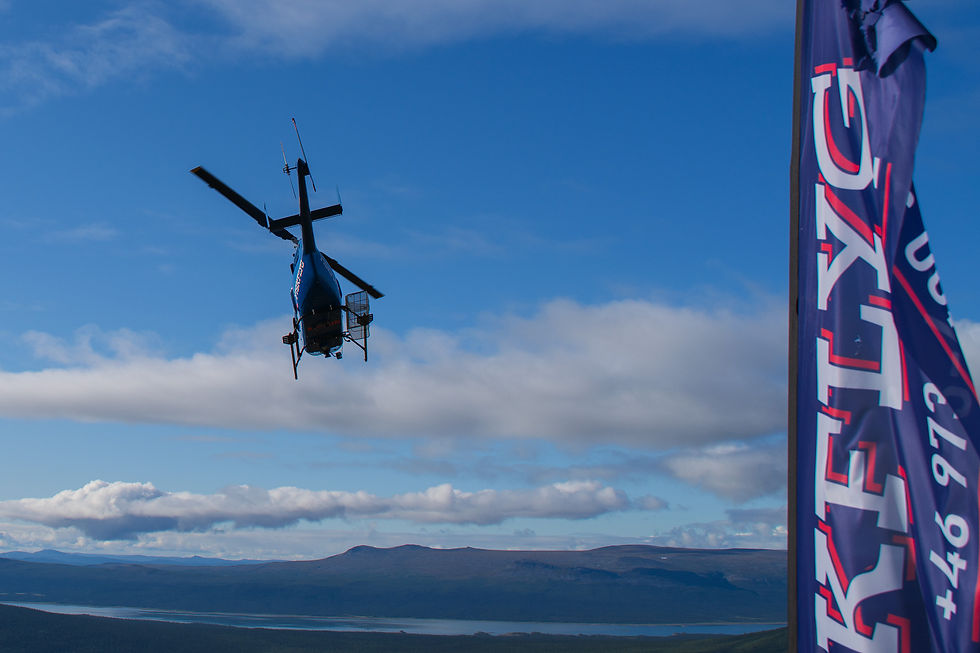
Standing there, with the helicopter shrinking into the distance, it struck me how different Sarek feels from the air and from the ground. From above, the landscape seems ordered, a little gem of forms and colours. On foot, every step reveals the park’s true nature: unpredictable, alive, and relentlessly wild.
From our drop-off point below Skierfe, the plan was simple in its outline but demanding in reality: climb toward the summit of Skierfe, take in the vast panoramic views down the Rapadalen, and then begin our multi-day traverse toward Aktse, a remote mountain cabin by the bends of the river and continuing my return to Kvikkjokk on the legendary Kungsleden hiking trail.
The ridge that leads up to Skierfe provides one of the most iconic approaches in the region. The trail, though not marked in the traditional sense, is well known to hikers and follows the contour lines, rising steadily out of the valley toward the summit. Once above the tree line, the world around you opens: the angled slopes drop away, revealing the braided waterways and distant snowy peaks framing the heart of Sarek.

From the top of Skierfe, looking down into Rapadalen, the swirling river channels and the flanking mountains are breathtaking. A reminder of the raw geological forces that have sculpted this land. Every shift of light brings new textures to the delta and ridges beyond, and it’s easy to lose hours simply watching shadows crawl across the valley floor.
Images shot with Sony A7 RV, Sigma 500mm F5,6 DG DN OS | Sports and Sigma 20mm F1.4 DG DN | Art
After absorbing the stillness at the summit, the plan is to descend back toward the east and make our way to the modest but welcoming outpost called Aktse, on the edge of the park where trekkers can rest, refill water, or make camp. The route down weaves through varied terrain: open plateaus, sedge-and-grass fells, and the rocky, windswept shoulders that are typical of Sarek’s outskirts.

From Aktse, the final leg will take me along portions of the Kungsleden trail back toward Kvikkjokk. This legendary long-distance route runs just outside Sarek’s boundary and connects remote cabins, lakes, and ridges over a length of dozens of kilometers part trail, part cultural pathway guiding us back across the edge of this ancient wilderness.
In Sarek, connection to the ground and the vastness of space is palpable; it’s a landscape that doesn’t just demand respect, but rewards those who move through it slowly, deliberately, and with attention.
After nearly fifty kilometers on foot, the sight of the fjällstation in Kvikkjokk felt almost unreal. The wilderness slowly loosened its grip, and with it came a quiet sense of completion. The days had been physically demanding, the backpack heavy, the terrain relentless, the weather a mixed bag with everything. More often than not, I chose to keep moving rather than reach for the camera. Not because the landscape lacked beauty, but because the effort itself demanded full presence. Some moments were meant to be carried in the body rather than captured in an image.
Stepping inside the station for a coffee and a hot shower to wash away dust and fatigue from the last 5 days felt never better. Not as an escape from the wilderness, but as a gentle re-entry. I'm grateful for the people I met along the way, spent time in the warm hut in Aktse, shared meals, stories and laughter along the trail.


Comments