
From Stetind to the Lyngen Alps

Updated: Feb 2

Leaving Stetind behind, the road led me further north into a landscape shaped by fjords and water. For the first time on this journey, ferries became part of the route. Driving the car onto the ferry felt unfamiliar at first, almost unsettling, but quickly turned into a welcome pause. Engines stopped, distances softened, and the landscape revealed itself from the water.

Crossing the fjords by ferry slowed everything down. Mountains rose directly from the sea, reflections shifted with the wind, and the sense of scale became more tangible. Travel was no longer just about moving forward, but about being present in between.

The Lyngen Alps emerged as a sharp, alpine contrast to the landscapes before. Steep ridges, glaciers, and narrow valleys define the region. Weather moves fast here. Clouds wrap around summits, light breaks through briefly, and scenes transform within minutes. It felt like a place that rewards patience more than planning.

Knowing that I was short on time during this part of the road trip, I chose the hike to Blåisvatnet deliberately. It felt like a place that could be reached within a limited window, yet still offered a strong sense of the Lyngen Alps. The hike begins quietly at the trailhead, without much ceremony. A narrow path leads through low vegetation and rocky ground, gradually gaining elevation as the valley opens up.
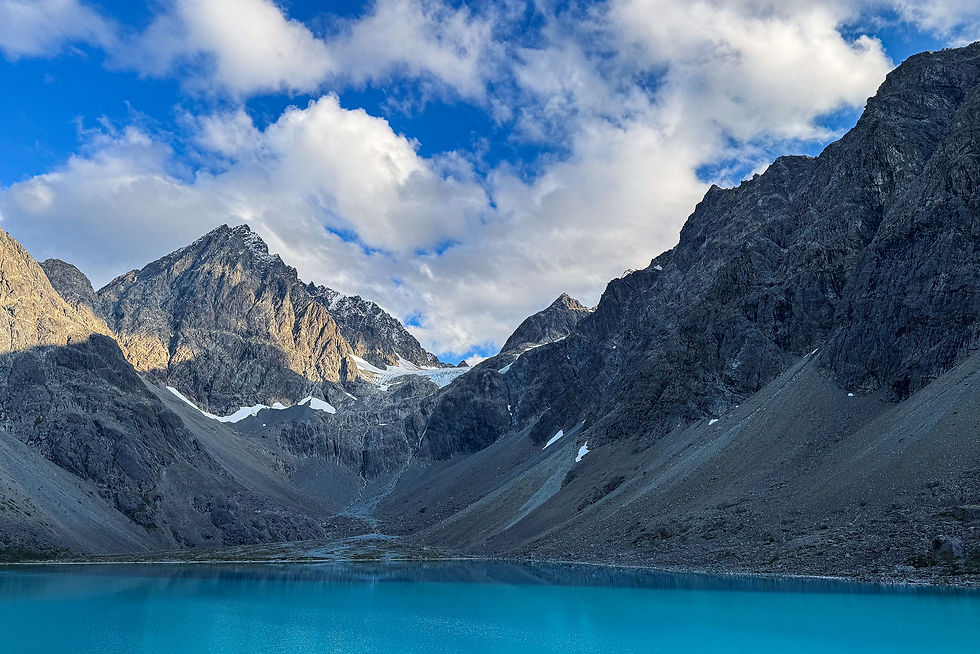
The terrain is uneven in places, demanding attention rather than speed, and the presence of water is constant. Small streams cross the trail, fed by melting ice higher up, and the sound of running water accompanies nearly every step. As the path climbs, the surroundings become increasingly alpine. Glaciers hang above the valley, and the landscape feels raw and exposed, shaped by ice and gravity.


For much of the hike, the weather was almost too good. Clear skies, flat light, and very little structure in the clouds made photography feel secondary, as if the landscape was holding back its character for later. When the lake finally came into view, its pale, milky turquoise colour stood in strong contrast to the darker rock and ice around it.
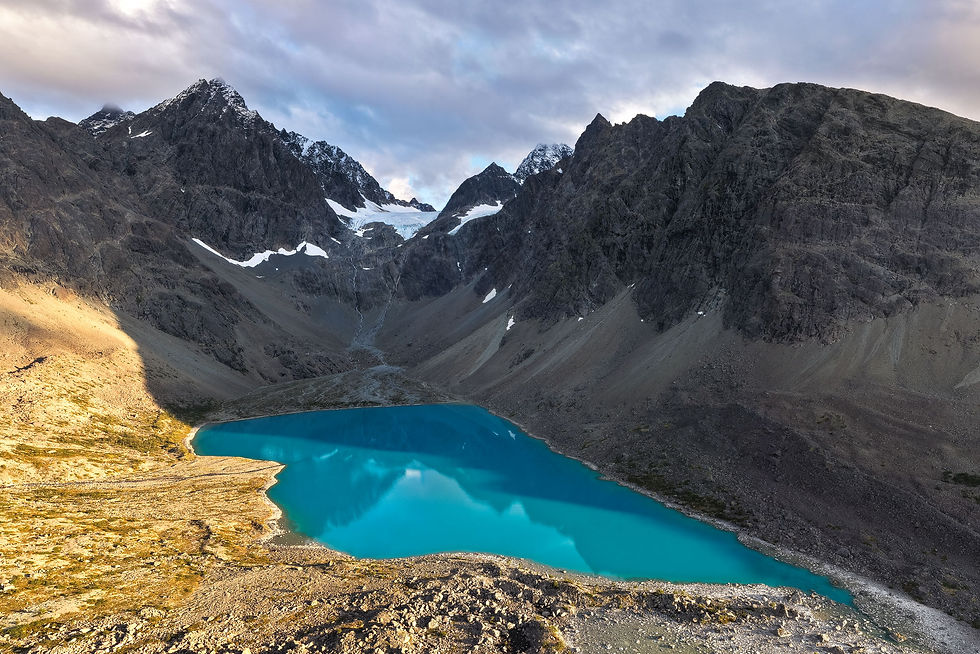
I stayed longer than planned, watching the nature change with the wind. Toward sunset, the atmosphere shifted quickly. Clouds moved in, light faded, and rain began to fall, closing the scene almost as abruptly as it had opened. It felt like a familiar pattern on this journey: moments of anticipation followed by acceptance. The hike itself, the changing conditions, and the time spent there mattered just as much as any image I might have hoped to make.


Continuing toward Senja, bridges and ferries connected fragments of land and sea. The landscape became rougher, more fractured. Mountains leaned steeply toward the ocean, coastlines dissolved into countless shapes, and the feeling of remoteness deepened. Senja didn’t present itself all at once. It unfolded slowly, demanding time, attention, and restraint.
This part of the journey marked another shift. Fewer kilometres, fewer decisions, and more waiting. Watching light change, listening to wind and water, and allowing the landscape to set the pace.

On the drive back from Blåisvatnet, I made one more stop for a hike to Lyngstuva Lighthouse at the very tip of the Lyngen Peninsula. From the official parking lot at the end of the road in Russelv, the trail leads along the shoreline and climbs gently toward the coast. The round-trip is around 6 km and typically takes about 2–3 hours on foot, with only moderate elevation gain — an easy walk that rewards patience with expansive views.

The path curves across open terrain, offering panoramic views of surrounding fjords and islands until the small red lighthouse appears against the backdrop of sea and sky. Reaching it felt less like arriving at a destination and more like standing at a boundary. Mountains slipping behind me and the focus shifting outward toward open water and distant light. After glaciers, valleys, and alpine terrain, this place offered a different kind of stillness, defined not by elevation or scale, but by openness and distance.
Close to the lighthouse, I came across the remains of a rusty shipwreck scattered among the rocks. There is little information about its origin, and no clear story attached to it. Judging by the structure and materials, it was likely once a working fishing vessel, abandoned or lost along this exposed stretch of coast many years ago.

Today, it feels less like a relic of an accident and more like a quiet reminder of how unforgiving this coastline can be. The rusted steel has merged with stone and moss, slowly becoming part of the terrain. Standing there, it was difficult to separate what once belonged to human effort from what now belongs entirely to the landscape.
On my way back, two reindeer appeared on the highest rock in the area, calmly watching over their territory.

With Lyngen slowly fading behind me, the road continued west toward Sommarøy, where land and sea blur into one another. From there, the journey would carry me onward to Senja.

Stay tuned for the next part of my journey.


Comments